01 · Surface
Side-panel UI
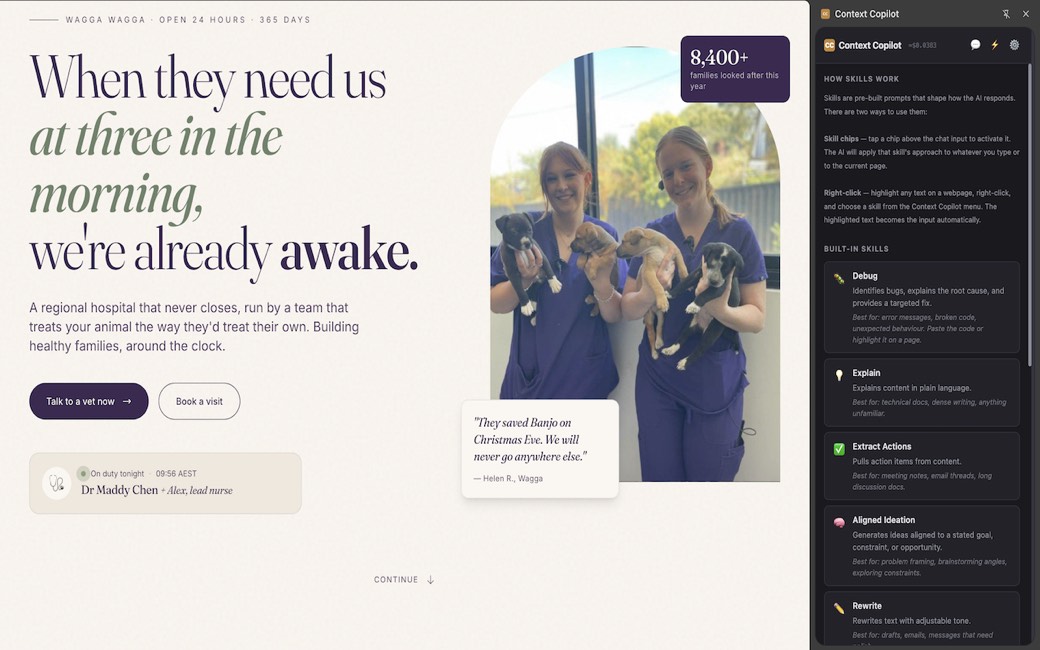
Vanilla JavaScript, one file, 530 lines. Skill chips, chat thread, voice button, settings, and the Pro-Prompt toggle. State in plain variables, rendered by rebuilding on change. No framework, no bundler.
Case study · crow_code_
Context Co-Pilot is a Chrome side-panel assistant that runs on the user's own API key. Private by construction: keys live in local browser storage, page content is read locally and never stored, zero backend, zero analytics. Model-agnostic, ten skills, voice input, a right-click menu. Shipped.
The opportunity
Knowledge work happens in browser tabs. AI lives in separate apps, separate subscriptions, separate windows. Copy out, paste in, copy back. Every context switch is a tax on attention.
Read a doc in one tab, switch to the AI tool in another, paste the selection, wait, switch back, apply it. Repeat for every paragraph and every email. The AI is always one window away from the work.
Subscription tools charge monthly whether you touch them or not. Browser wrappers route requests through a vendor proxy, so your prompts and your key behaviour are visible to a third party.
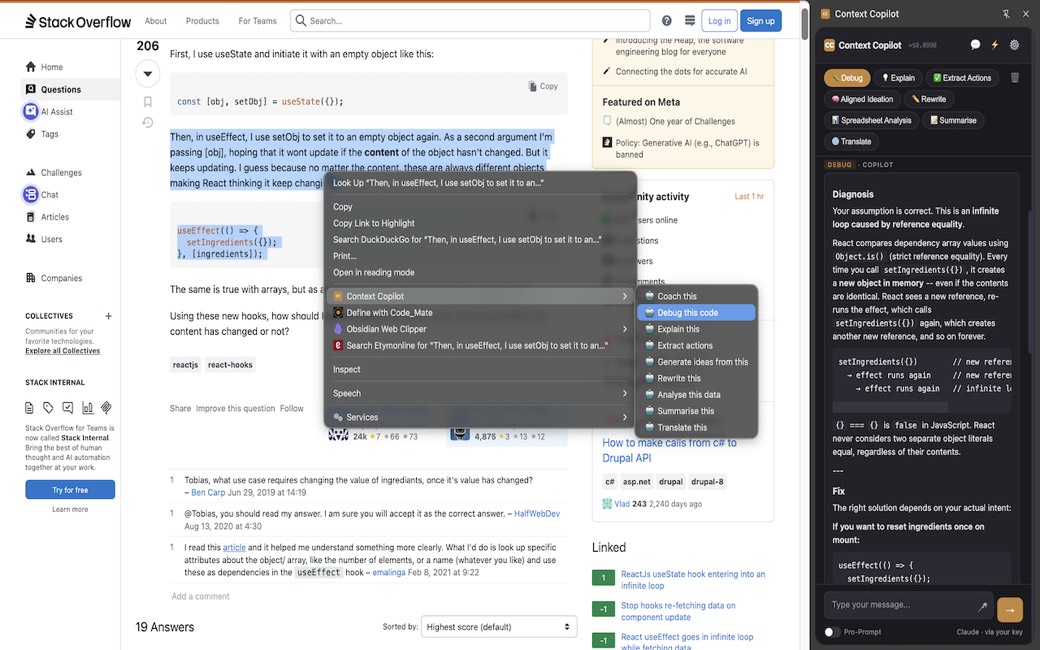
Open the side panel on any page. Select text, right-click, pick a skill. The response streams back beside the work. No tab switch, no paste.
Bring your own key. Calls go from the browser straight to the provider: no proxy, no middleware, no third party. Keys live in local storage, and the extension owns nothing about you by design.
The surface
A Chrome side panel that docks to the right of any tab. Skill chips, streaming responses, voice input, a right-click menu. No overlay, no popup.
What was built
Six systems collapsed into a service worker, a side-panel UI, and a content script. Loaded straight by Chrome, packaged for the store as-is.
Vanilla JavaScript, one file, 530 lines. Skill chips, chat thread, voice button, settings, and the Pro-Prompt toggle. State in plain variables, rendered by rebuilding on change. No framework, no bundler.
510 lines. Seeds the default skills on install, builds the context menus, resolves the provider from the key present, calls Anthropic or OpenAI directly, and streams responses back to the panel over a port.
122 lines. Extracts the selection or falls back to the full page, and wraps the Web Speech API for voice. URL-restricted so it never injects on browser-internal pages, returning a clean error instead of a silent failure.
Keys live in local browser storage and never leave it, except to reach the model provider directly. The provider auto-selects from the key present. No backend to compromise, because there is no backend.
Summarise, Rewrite, Explain, Translate, Extract Actions, Spreadsheet, Aligned Ideation, Debug, Free Chat, and Pro-Prompt. Each is a stored record, so custom skills drop in later with no code change.
An optional pass that runs the prompt through a lighter model to sharpen it before the main call. A first-use note explains the cost trade, and the before-and-after sits inline so the user sees what changed.
What was overcome
Manifest V3 service workers are ephemeral, so a streamed response would die mid-token when the worker spun down.
The worker stays alive while a runtime port is open. The panel opens the port, the worker pumps the stream through it, and the port keeps the worker resident for the duration.
The panel connects a named stream port. The worker writes chunks until the API stream ends, then closes the port. It streams cleanly to completion every time.
Trust without a backend. Users will not enter an API key into an unfamiliar extension if it might exfiltrate the key.
The only fix is to give them nothing to trust. No backend, no proxy, no analytics. All the code ships to the store and sits in git, readable and runnable by anyone.
Keys live in local storage, requests go straight to the provider, and the privacy panel states plainly what is and is not collected. None of it is. The audit takes ten minutes.
Context Co-Pilot is live and free on the Chrome Web Store. Ten skills, two providers, voice input, streaming responses, and zero backend to compromise, because there is no backend. The user owns the key, the data, and the spend.
Get it on the Chrome Web Store